Athlete Spotlight – Evans Rohrbaugh

If you follow the hashtag #SoSAthlete, you’ve probably seen SoS Ambassador Evans killing it. He’s getting in his workouts and bringing his all to events. We recently sat down with Evans to learn more about his background in sport, and find out why he’s loving his experience with Science of Speed and Coach Brady.

SoS: Evans, tell me a little bit about your background in sport. How did you come to be active and what have been some of your proudest accomplishments?

Science-of-Speed-Evans-Rohrbaugh.jpg#asset:368

Evans: I’ve been on 2 wheels since I was 12. I started out in BMX in the early 80’s (like a lot of kids of my generation,) then I got a MTB in the early 90’s. Shortly after that, I got my first road bike. I raced it and MTB a few times in the 90’s. Then, in early 2000’s, I joined a team and started racing road and cyclocross. In 2003, I got burnt out and didn’t touch a bike again until 2009. One day, I looked in the mirror and I was 55lbs more than when I stopped riding. I realized riding was what truly made me happy and it’s been flat out ever since. Since 2009, I’ve raced road, cyclocross, Track (velodrome), mountain bike and, for the first time recently, duathlon. I decided that and time trials were what I wanted to concentrate on in 2019.

SoS: Before coming to SoS, had you worked with a coach before?

Evans: I have worked with 2 different coaches before.  One sucked at communicating, the other got busy, stopped communicating, and raised his rates.

SoS: What a bummer. How has your experience working with Coach Brady been different from your previous coaches?

Evans: Brady has been great to work with. He communicates well , has my plans set up in advance so I can work them into my life, and I can tell he loves to ride as much as I do !!

SoS: Glad to hear it! What goal events do you have coming up?

Evans: As of right now, my main goal is a good placing (age group) at Duathlon Nationals in April.

SoS: We know you can make that result happen. What are some of your favorite results that you’ve seen since becoming an SoS Athlete?

Evans: Super happy with my results so far in running, fifth in age group in my first off road / trail race, sixth in age group at a four miler , and a tenth in age group in my first 10k.

Ready to see great results and love your coaching experience? Contact us today for the scoop on custom coaching!

Group Riding 101

A group ride is a great thing!  It increases one’s ability to go faster while simultaneously decreasing perceived exertion.  This is often done by drafting off of the rider in front of you in an effort to reduce the forces of wind (natural or created by you) on you as a rider.

There are three basics to group riding that will make other cyclists want to ride with you and even fight over your wheel because they trust you.

Be Predictable

heading-02@2x.jpg#asset:51

When riding in close proximity to other riders, the most important thing you can do is be predictable.  This could mean that you are pointing your hand to where you are going, are telling riders of debris and anything in the road, but, most importantly, it means to be slow and calculated in your movements.  Unlike in basketball, you want to telegraph your movements so that others know what to expect of you. No swerving, panicked braking or other erratic movements.

Pull Through Smoothly

It is very easy to get caught up in the excitement of a group ride, especially when it is your turn you go to the front and give it everything you have to “help the group.”  While in theory this is a very selfless act, it actually puts a strain on the entire group. The people sitting on your wheel will have to close the gap and the rider who has just pulled off the front of the group now has to work very hard to get back on.

We recommend you use your tools to help you with this.  As the person pulls off in front of you and it is your turn to pull through, cadence and speed should not change drastically.  The force applied to the pedals will increase, as you are catching more wind, but, by maintaining speed and cadence, you will ensure that the effort stays the same for all people involved.

Watch What is Ahead

It is easy to fall prey to the nasty habit of staring at the wheel of the person in front of you. However, your eyes should be focused over the should of the rider in front of you.  This allows you to see what is going on up the road and respond before it becomes a panic situation, but still allows you to use your peripheral vision to maintain a safe distance to the rider in front of you.

When on the front of the group you are responsible for the safety of the entire group.  It is important that you are scanning the road for hazards and signalling for them in whatever manner your group deems as helpful.

Are you unsure how to get into a group ride and what to look for?  Be sure to read our blog on your First Time in a Group Ride and learn some best practices for your first time riding with a new group.  Maybe you have that group and are wanting to learn more!  Continue on to Group Riding 201 and increase your knowledge

​Back In The Saddle

Sometimes, athletes step away from training due to injury, other times to reflect on their goals. No matter the reason, absence can indeed make the heart grow fonder. Even if you’re looking forward to starting a new training cycling, returning to a routine after a break has its difficulties. Long-time SoS Athlete Kearstin recently started up her custom coaching again after a hiatus. We asked her about her experience in returning to her training regimine.

SOS: What’s it like to come back into training with your coach after a break? Is it easier because of the customization of your workouts?

Science-of-Speed-Athlete-Kearstin-Hess.jpg#asset:326

KR: I think the hardest thing is seeing how much power and endurance I lost before training again. At first, I was really embarrassed by not being able to do rides I used to do, but Coach Brady has been the perfect amount of push and compassion that I need in a coach. It is definitely easier with the customization of workouts! I tried making a comeback on the bike by myself and I just needed more structure and guidance. That’s what I get from Science of Speed.

SOS: What goal events are on the horizon for you as you return to training?

KR: I’ve had one elusive goal for the past 3 years now. I’d like to be able to qualify for the Race Across America. To qualify, I have to complete 370 miles in 24 hours. That is what I’m currently training for and the race is in February. While I don’t know if I’ll be able to hit that goal this next February, I’m just excited to be getting my fitness back!

SOS: Overall, how have you liked working with your SoS Coach? What have been your favorite results that you’ve seen in the past from your customized training?

KR: I love working with SoS. I’ve used SoS on and off for the past 3 years and I’ve always been my best self on the bike when I’m being coached by them. While the results are slow going at the moment, I love what I’m seeing now. I honestly feel like we are starting from ground zero and every week I see improvements or, at the very least, I feel good about myself.

Looking to get back in the saddle and rededicate yourself to your goals? We’re here for you at every step of your athletic journey. Let’s get you ready to return to the race course. Contact us today.

How to Properly Train with Heart Rate

Congratulations on your new heart rate monitor!  Adding a form of tracking to your training helps you to increase the accuracy and consistency of your efforts.  While using a heart rate monitor in your training, there are two things to consider.

HR is a Response

When using Heart rate as a training tool, it is important to realize that heart rate (HR) is the response to the work that you have done.  This is crucial in the effectiveness of your training because what your heart rate is currently telling you is symbolic of the workload that you completed 20-60 seconds prior.

Cardiac Drift

Cardiac-Drift.png#asset:324

Cardiac drift is the upward trend in heart rate during longer sustained efforts.  It is an increase in heart rate that is caused by a more highly activated Sympathetic Nervous System (think fight or flight response), increased core temperature and total body water losses.

With this new knowledge in mind, it is important to pair your workouts with perceived exertion. In other words, how hard do you feel you’re working? This will provide you with a system of checks and balances that will keep you from beginning workouts too hard and ending them too easy as you would if you were to maintain a flat heart rate for the entirety of your efforts.

Take your training to a new level with one of our Static Training plans!  These low cost, high output training plans will produce amazing results when paired with your new knowledge of heart rate training.

Noassatall – The Plight of the Runner, and Many Americans

Noassatall is not selective.  It impacts men and women of all ages, ethnicities and backgrounds.  This is common among many Americans and, most surprisingly, among many endurance runners.  What is Noassatall? It is where someone turns sideways and, looking at the back side of their profile, you question whether you are staring down a wall or a human body.  Let’s be honest, we are supposed to have curves back there and many individuals do not.

The predominant muscle in our butt, the gluteus maximus, is in charge of many things including sitting/standing, climbing stairs, giving you some junk in the trunk and even maintaining an upright posture.  A weak gluteus maximus muscle can lead to poor posture and over compensation for many of the complimenting muscles potentially resulting in injury.

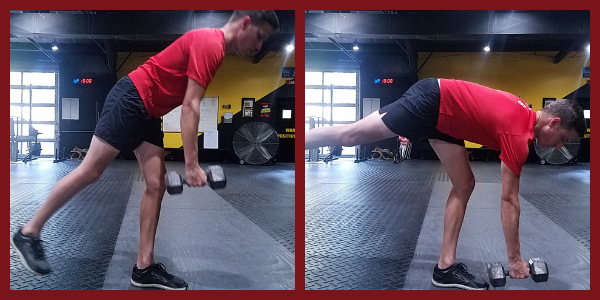
Looking to help fight against Noassatall?  Try this exercise to improve your glute strength, better balance your body and even improve your run.

Single Leg Romanian Deadlift:

  1. Hold one dumbbell or kettlebell in your hand.
  2. On the opposite side that you hold the kettlebell/dumbbell, stand on one leg.
  3. Keeping your standing leg knee slightly bent, perform a stiff-legged deadlift by bending at the hip, extending your free leg behind you for balance.
  4. Continue lowering the kettlebell/dumbbell until your back is parallel to the ground, and then return to the upright position. Repeat for the desired number of repetitions. Need to increase the intensity? Increase your weight or number of repetitions.
oNZmCl7pesk0e4Eo1glPzuuwynE7ZBWwxwuTYmoXJK9ARjWZBZd65twY977w9K4ibhDf4xMmzEmUZyb26fAAxrHLLzqGYRYE8CHqiJmoIs2qhQZFAjHmebpppVNpnQmImUpmTX4M

If you are an endurance athlete who feels lost in a weight room, you’re not alone — but you are at a disadvantage. Strength training could be the key to unlocking your next improvement on the race course. Join us at the Endurance Training Club for our strength training class to build your butt and all your other key muscle groups. Have no fear — this won’t be a power lifting session. All of your ETC classes are designed for endurance athletes, by endurance athletes and are built to be accessible to you. We look forward to seeing you — book your class now.

Race Day Nutrition 101

Event day nutrition is something that can be confusing for those who are new to endurance sports.  Outside of athletics, we are accustomed to eating three balanced meals and watching what we eat so that we are not constantly fight the battle of the bulge.  On top of that, the quality of the food we eat is stressed. Is it non-gmo, free range, organic, gluten free? Does it provide you with the macro and micro nutrients that you need to sustain healthy body function?

With all of this detail paid to our daily nutrition, training nutrition is very easy to overthink.  If you find yourself stressing, it is time to reassess your training and racing nutrition.

It is important to preface the follow statements with the fact that these recommendations are geared to athletes who are just beginning their nutritional journey and are doing events that take 4 hours or less.

Whether in an event or training for an event, three key elements need to be considered.

shutterstock_259086626.jpg#asset:265

Pre-event: The goal of pre-event nutrition is to provide the energy necessary to top off your body’s fuel tank (glycogen stores.)  Caloric intake will vary from 200-600 calories, dependent upon time since last eating, the intensity of the event and your ability to handle food prior to physical activity.  The timing typically varies from 15 minutes to 2 hours prior to activity.

During: Nutrition while training or racing will vary heavily upon the duration, intensity of the event and athlete size/stature.  Your #1 goal is to fuel your performance. Because of this, your primary calorie consumption should be carbohydrates. Caloric intake can vary from 100-350 calories per hour.

Post-event: Unlike pre-event and during-event nutrition, your goal shifts from performance generation to physical recovery.

These are just some things to consider when building your training and racing nutrition plan. If you’re interested in how to fuel yourself for best results, our Science of Speed coaches will be happy to provide guidance based on their personal racing and training experiences. As well, SoS can connect you with a nutritionist that understands the athlete’s body.

Losing Power but Gaining Speed

Recently, an article was posted regarding the loss in power production of cyclists when they transition from a position on the hood to aerobars.  Among bike fit specialists and many high level cyclists, this is nothing new. It is common knowledge that the position of a time trial or triathlon bike is less bio-mechanically efficient than a road bicycle.  The goal with this position is not to increase a rider’s power output. It is to optimize the balance of efficiency and aerodynamics.

Blog-Twitter.png#asset:311The key point here is that you, as an athlete, should be able to spend as much time in this position as possible.  If you are striving for a very “aggressive” aerodynamic position, it may take time for you to adapt. Unfortunately, we too often see people riding on the horns of their bars because they are uncomfortable in the aero position.  If you have been in the same position for more than 6 months on your TT/Triathlon bike, it is time to reassess your position.

Why is that the case?  Any time that you are out of the aerobars, you lose the vast majority of the purpose and function of your bike.  The other reason this is very important is because the recruitment of muscles is very different from the horns to the aerobars.  We are not only speaking of leg muscle recruitment (quadriceps, hamstrings, and glutes,) but also the utilization of neck, shoulder and back muscle recruitment that is varied by this position.

You can read the original article here.

Have questions about your bike position? Our expert bike fit specialists are here to help you get comfortable. Contact us today about a bike fit.

Are You Running or Riding in Circles?

With every workout that our Science of Speed coaches post in an athlete’s training schedule, there is either a workout distance and/or a time designated for the workout.  Typically, we prescribe a length of time with intensity as a variable, but the reason for that is an entirely different article in itself. These workouts are set up with a specific goal in mind and are designed to create create stress on the body to result in optimal performance gains.

As we are analyzing training files, we sometimes see athletes who are more particular about reaching those specific times within very narrow margins.  In some cases, it is as severe as doing laps around a parking lot to get to the 2:00.00 hour mark or .00 of a mile. Is this you?

I recently completed a ride that I ended at 1:56.17 and 56.3km (34.98miles) and posted it to Facebook asking if my friends and followers would feel compelled to keep going towards that round number of time or distance. It was more common for athletes to end up riding or running to get to the next even/whole number.  

So, I pose to you this question.  Is it compulsion or methodology that is leading you to do this?  If there is a method to your madness that is great and you may keep going, but if it is obsession or anxiety that motivates this then I implore you to take a moment, with an open mind, and consider the following points.

Physiology – Our bodies are very responsive to training but we need to keep in mind that they are not so incredibly malleable that running circles in a parking lot to finish out an endurance workout is going to improve overall fitness.  A 5-10% buffer is perfectly acceptable and will not have significant impacts on your overall fitness.

Methodology – As we are designing training plans, we factor in three key variables: time, intensity and frequency.  These work synergistically to create a desired overload with increased fitness, strength and performance as the overall goal.  Much of our training plan design goes into interval training– a higher, focused intensity or effort with bouts of recovery in between.  These intervals are the primary part of the workout and what we see as the most important part. If you push the “recovery” phase of the interval too much, you negatively impact the quality of your intervals and, once you are done with the final interval, the meat and potatoes of that workout is done. Unless otherwise stated, a cooldown is sufficient enough to be completed for the day.

One experienced cyclist and ultra runner made a very valid point.  Paraphrasing, they said, “If my training plan said 2:00.00 and I got to that time on my ride, but still had 4 minutes of riding to get home, would I call my wife?”  Upon reading this, it only solidified my pre-existing view point that you might as well end several minutes early if you won’t be calling for a ride.

Understanding why your workouts are designed a certain way can be tricky — especially if you’re dealing with a one-size-fits-all training plan where the workouts weren’t designed for you. If you’re interested in having a resource to not only build, but also explain the purpose of your workouts and what is most important, I encourage you to reach out to Science of Speed about customized coaching to get the expert guidance that will lead to both knowledge and success.

Best,
Coach Brady

Welcome to the Endurance Training Club

Untitled-design.png#asset:306

Welcome to the the place even your coach would want you to workout at!

Science of Speed’s Endurance Training Club

Science of Speed’s Endurance Training Club is the center of your fitness adventure.  Experience endurance workouts, strength training, recovery modalities and the fun and challenges that keep us working hard.  The Endurance Training Club offers everything the endurance athlete needs to be well prepared for each event that they participate in.  

Our cycling trainer classes provide you with structured interval workouts to challenge athletes at their own personalized training ranges, while simultaneously pushing you when it is needed most.

Strength classes help to strengthen the common weaknesses that endurance athletes battle, helping to prolong time in sport, increase overall strength and ultimately improve quality of life.

Recovery is a very important aspect of training that is often overlooked. Participating in one of our various recovery classes will help you to stay limber, increase blood flow to fatigued muscle tissue and decrease the side effects of Delayed Onset Muscle Soreness.  

What does being a member of the Endurance Training Club provide you?  Accessibility to our classes that are specifically designed to help athletes increase fitness and help to reduce the risk of sport related injuries. Members can also enjoy discounted rates on testing services.Schedule Appointment

Membership

Monthly – As Low As $65/month

Individual Class – $15/class

Personalized onsite training is available by appointment @ an hourly rate

Monday

  • 6:00 am Trainer Class
  • 7:00 am Strength

Tuesday

  • 6:00 pm Trainer Class (Could be switched with a run workout if necessary/requested)

Wednesday

  • 6:00 am Trainer Class

Thursday

  • 6:00 pm  Trainer Class
  • 7:00 pm Strength

Friday

Saturday

Schedule Appointment

  • 11:00 am Active Recovery

*Class availability and times are subject to change.

Beat Pre-Event Anxiety

shutterstock_130533281.jpg#asset:296
The brain is a miraculously powerful organ.  It is capable of deep thought and incredible ingenuity that has brought civilization amazing literary works, the ability for humans to fly, the Pythagorean Theorem and the Snuggy.  Unfortunately, the brain can also be a powerful device for evil, too. It has lead to the destruction of many civilizations, hurtful words and the creation of Crystal Pepsi.

Over the past years, I have seen the power of the mind be nearly debilitating for many endurance athletes.  It has created sub standard results, levels of frustration and, for some, it even creates stress that is great enough to cause vomiting.

Why is this? In an age of cell phones, emails, TPS reports and board meetings, our “fight or flight” responses have taken a bit of a turn in what they respond to.  It no longer takes a saber tooth tiger lurking in the bushes to trigger our sympathetic response. It is now these new stressors that create our “fight or flight,” and, for athletes, a big race is the reason for the dump of norepinepherine and epinepherine getting both our bodies and minds jacked and ready to go for broke in an all out fight to the death.

Variables such as upbringing, personality, life experiences and even ethnicity and gender can change our reaction. The important thing is how can we counteract these high levels of anxiety and stress, and turn what would be a negative into a positive, performance enhancing result.  Here are several steps we recommend you try to start and then fine tune to your specific needs:

Acknowledge the Stress – Remember: this is your body’s way of preparing for battle! These chemicals that have been released are preparing you for your best performance yet and your interpretation of this stress has an impact on the final outcome.

Refocus the Stress – Your heart rate is elevated and you have a pit in your stomach, but you can still take control.  The key is to turn this negative impacting force into something positive and you can do that by:

  • shutterstock_449081995.jpg#asset:295Positive self talk- It doesn’t have to be complex, something as simple as, “I am ready for this race and I will do great!” on repeat in your head, or even out loud, could be enough to recenter you and get you under control.
  • Developing Self Confidence – Rely on your past experiences to solidify your confidence in your ability to compete/complete the event.  You can draw on previous positive race experiences or even amazing training workouts that drove home the fact you are physically prepared.
  • Distraction – This can be a bit more difficult to accomplish because setting, people and scenarios change but if you have a person (spouse, significant other or friend) that you often travel with to events they can provided a nice added distraction.  Getting lost in music on your headphones can be a helpful options and with the right play list it can help to get you excited to race.
  • Focus on the details within your control – There are many factors on event day that you have no ability to control.  Events starting on time, weather, traffic or other people’s actions are far from your control, but you can own so many other key variables.  These include things like the time you leave for the event, the food you eat, your clothing selection and the condition of your equipment. Some of these may take preparation leading up to the event, but you will know that you have your details under control.

Have a plan – For many athletes, battling pre-race anxiety it is not a one time occurrence.  It has happened over and over again. It reduces expected performance, causes a lack of confidence in ability and, in worst cases, it is event ending.  If this is you, it is important to create a plan prior to race day. You know what you are likely to experience on event day, so it is time to create a plan for your day.  Keep in mind things such as: Food, travel, equipment, clothing, meditation, warm-up and hydration. The plans for each person can be very different, much like training, but it is important to create and then fine tune a plan for yourself.

Are you struggling to find a way to conquer your pre-event anxiety?  Let one of our coaches help you build both the physical and mental strength you need to succeed.