t’s one of the top questions we get from our athletes: “Hey Coach, how do I connect my Garmin watch data with my TrainingPeaks account?”
Garmin GPS watches and bike computers are some of the most popular pieces of technology for cyclists, runners, and triathletes. We encourage our SoS athletes to use these small, but mighty gadgets to provide us with data from their workouts. For us to truly understand the results of your training, we must link up your Training Peaks account with your Garmin account. Here’s how!
Garmin provides an autosync function which will do all the work for you once it is enabled. Everytime you upload a workout, it will automagically upload to TrainingPeaks as well.
Setting Up Autosync
Ensure you know the login for both your GarminConnect and TrainingPeaks accounts.
Click here and click the button that says ‘Autosync Now.’
Select ‘I have past activities in Garmin Connect’ if you have been using your Garmin product in the past. Select ‘I’m starting fresh’ if you have a brand new device or do not wish to share old workouts on to Training Peaks.
Login to TrainingPeaks when prompted.
Login to Garmin Connect when prompted.
Read through the terms of service and click “I consent.”
Woohoo! Your accounts are now connected.
To see the results of the connection, go complete a workout with a device and sync your new workout to Garmin Connect. This upload will immediately sync to TrainingPeaks and trigger all past activities to be synced as well. In about a week, all of your past activities will begin to appear in TrainingPeaks.
At Science of Speed, we are constantly striving to help you make the most of your training. We are excited to announce the launch of a new program that will make your SoS experience more rewarding than ever. We know that many of you are kind to recommend us to your friends and family in sport. To ensure you know how grateful we are, we are launching an athlete rewards program. Starting this month, SoS Athletes who are receiving custom coaching services can earn monetary credit towards coaching, testing, swag from the SoS Shop, or any other Science of Speed purchase.
How do you earn these rewards? For every athlete that you refer to us that purchases one of the following services, you’ll receive a corresponding amount of credit towards your Athlete Rewards balance:
Custom Static Training Plans – $10
Custom Coaching Plans – $50
Retul Bike Fit – $15
The Endurance Club (monthly membership) – $10
So, how do you ensure that you receive credit for your referral? We’ve added a field called “Referred by:” to the contact form here on our website. When your friend, family member, training partner, etc. reaches out to us, be sure to let them know to put your name in this box.
If your referral purchases one of these services through the SoS Speed Shop, have them drop us an email to let us know you pointed them our way — or simply have them add it to the Notes section of their order.
We’ll look forward to hearing from your connections and comrades. We are honored to have your recommendation, and are so proud to know that many of our new athletes were encourage by our current customers. It is the greatest compliment we could receive and we are incredibly appreciative.
Ready, set, EARN! You can find the Contact Us form here.
A recent research study from Northumbria University in the UK showed the importance of the power of perception. In this study, athletes were tasked with an initial 4km time trial in order to achieve a baseline result. Once the baseline result was achieved, two subsequent 4km efforts were performed. One effort was at the same power as the initial effort and the other was 102% of the initial effort, unbeknownst to the athlete.
The athletes who were at the same level, on average performed slightly lower than 100%. When athletes were given a pacer that was at 102% of their baseline, they were able to improve their performance, showed no signs of exercise-induced neuromuscular fatigue and rate of perceived exertion (RPE) was the same as their baseline.
At Science of Speed, we believe that every workout should have a purpose. Bear in mind that all of those purposes aren’t just to improve performance. They can be as simple as fun, camaraderie or, as this study supports, for a mental reset on what “hard” really is. Much like the Northumbria study, we have seen that by altering athlete’s perception of what high intensity is we can alter their ability to push beyond what they previously felt was possible. In this research article from Oxford Brookes University in the United Kingdom, we see the same concept being tested in a laboratory. As our coaches have experienced with our athletes, there is more than one reason to structure intervals other than the physiological adaptations that occur. Here, a psychological adaptation resulted in an increase in time to exhaustion (TTE) and an increase in their pain tolerance by 41% when compared to athletes who completed moderate continuous training over the same six week period.
It may be hard for you to recognize the potential that lies in you. It may be hard to know how to unlock that potential and push beyond the mental barriers that may be holding you back. Working with educated and experienced advisors can help you build confidence and develop the mindset you need to succeed.
Curious how coaching can help you strengthen the body AND the mind? Contact us today.
For several years now, beet juice (beetroot juice if you are in Europe) has been an exciting topic of discussion in human endurance performance. Our coaches have been utilizing beet juice — as well as a number of our athletes — and many of them have experienced and benefited from the increased blood nitric oxide boost that beet juice provides. This nitric oxide has great effect on our bodies from both health and performance standpoints.
Let’s break down the benefits, and you can decide if you’d like to add this ingredient to your nutrition.
Physiological Changes
When it comes to health issues in the United States, the greatest benefit of beet juice has to be decreased blood pressure. With one of the top 5 U.S. prescribed drugs of 2015 being a blood pressure regulator, this offers a great alternative. By drinking as little as 8 ounces of juiced beets a day, you can see a nearly immediate decrease in blood pressure. Healthy blood pressure is great for all, but what benefits will athletes be most drawn to? Consuming beet juice has also shown a reduction in oxygen cost of exercise in some subjects. This ultimately means that, per oxygen molecule your body is utilizing, you are now producing more work. Think of it like this: you are boosting your bodies miles per gallon! This increase in efficiency allows you to get more out of your workouts or performances for less energy.
Mental Benefits
A great amount of research has shown that beet juice supplementation has lead to an increased blood flow to the brain due to its associated vasodilation. (Vasodilation is the dilation of blood vessels, i.e. that decrease in blood pressure we talked about earlier!) We also found it interesting that it has even been shown that, when paired with exercise, consuming beet juice has resulted in an increase the neuroplasticity of the brain in older subjects. This means that functions are able to be “remapped” in the brain. This definitely sparked our curiosity about a benefit to subjects with brain trauma.
Performance Benefits
Let’s be honest. Most of you who are reading this are more concerned about whether or not this is an ergogenic aid. (Scratching your head? An ergogenic aid is something that enhances performances or gives edge to an athlete.) While beet juice supplementation has shown some small benefits in sprint performance with the most significant area being in a reduced time of athletes reaching peak force generation, there is no significant evidence of beet juice being a major performance enhancer. That is not to say that beet juice does not have performance benefits. In our opinion, the biggest benefit to our endurance athletes is the findings of increased endurance exercise capacity. What that means to you is that you will be able to sustain your effort for a longer period of time before reaching failure. There is some potential of beet juice to also be an ergogenic aid at altitude. This may be of interest to many who live at sea level and go to altitude for events.
If this post sparked your interest, here’s how to add this into your diet.
Recommended dosing:
The amounts of
6/8 mMol which is roughly 1-2 shots a day
2-3 hours prior to competition (time it takes (approx.) for the body to process)
Take 4-15 days prior to competition – (if not taking daily)
One thing to note if you are drinking beet juice: It can discolor your urine and fecal matter. This is called beeturia.
As athletes first getting into a sport, there is a lot of room for improvement. With each workout or activity, we become faster, stronger and more fit. PRs are set, breakthrough workouts occur and fitness continues to grow. Eventually, we all reach a point where we either run out of knowledge on how to improve or the methods being utilized begin to show less and less in regards to the gains that are seen.
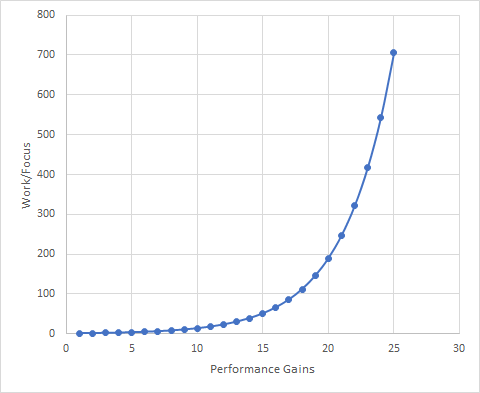
Training is much like an exponential growth curve. Gains come easy early in our training experiences. Our bodies are amazing at adapting to stress. VO2 max increases, more mitochondria form to provide energy for the muscles, increases in red blood cell count can increase to compensate for the increased demand in oxygen to the tissue, muscles become larger and/or stronger and even our heart adapts. As we begin to increase fitness and these adaptations occur, there is a point where the same training doesn’t have the same results. When this happens, an athlete must become better educated and learn how to modify a training plan to become a better athlete.
Often times, our coaches find that athletes do not realize this. The subsequent result is a plateau. You might be doing the same ol’ two group workouts a week, one gray zone workout and that killer gym workout. They might still leave you wobbly legged. Yet, no improvement on a Strava KOM or you end up getting shelled from the group ride at the exact same spot.
A change must be made! A change to improve, to hunt for those marginal gains, no matter how unachievable they may seem and to improve your fitness with new levels of thinking. Break outside of your current box and let your fitness expand with one of these three changes!
Increase Intensity – It is easy to fall into a rut of what is comfortable and convenient. Unfortunately this often means that we are not pushing our body to a point of adaptation. Try adding intervals into your training. This doesn’t mean it has to be a structure interval workout, you can simply increases your pulls at the front of your group ride, or push yourself more on hills or into headwinds. The ultimate goal is to increase your time at intensity.
Increase Volume – If the time is available you can always add on more volume in riding. Remember that because you simply add on distance you still need to maintain a reasonable pace and not simply lollygag.
Increase Frequency – Add another day of exercising into your routine. The added mileage will place additional stress on the body and will help elicit a physiologic response resulting in better performance.
March was a busy month for SoS Athletes and Coaches — and it’s showing in all their excellent results. As we welcome the month of April, let’s look back on the big wins and improvements made by athletes working with Science of Speed to reach their goals!
Shoutout to #SoSAthlete Eric who, in just 11 weeks of training, has seen an 8.5% increase in power at threshold! Keep up the great work, Eric.
Five months ago, Earl took his last field test. After hard blocks of winter training with SoS, this athlete is 11.5% higher at threshold than the last test. Working hard to gain those watts! Nice work, Earl!
A hard winter of training with Coach Alex has paid off for Mason. A PR in the 1600, as well as 3rd in the 1600 and 1st in the 3200 just a couple weeks earlier! Congratulations Mason!
Shoutout to SoS Athlete, Eric! He took on the SEC#2 Old Capital Classic 6 HR MTN BIKE RACE in Milledgeville, GA and took home 2nd place for XC 1 PRO/EXPERT. Nice work!
What an amazing performance from SoS athlete, Stacy! Congratulations to you and Coach Armando on meeting goals and making PRs happen at Best Damn Race – Orlando, FL!
Congrats to Jake Oswald who took 1st place overall at Tour de Murrietta Stage Race – Category 5!
This one goes to our PR guru, Meg! On her last field test, she cut 1 minute 4 seconds off of her threshold pace.
Congrats to Coach Brady on a successful launch of the Champions Ride, a new nonprofit cycling event in north Florida. The event raised close to $10,000 for a local charity.
Ready for some new accomplishments of your own? Contact us today and let’s set exciting goals today!
While Science of Speed coaches are offering athletes across the country advice and guiding them towards their goals, they are also athletes themselves. From swimming to cycling, from triathlon to obstacle racing, our staff is out chasing their own dreams in sports of all kinds. It is because of this that we believe they connect so well with their athletes during training. They understand the grind of training and know what it takes to succeed.
Coach Brady recently put his legs to work off the bike and on the run at the Snicker’s Albany Half Marathon in Georgia. Here are his recap of race day and key takeaways for other athletes.
At the end of 2017, I began training for the Snicker’s Albany Half Marathon. For those of you who have followed my journey over the past two years, I made it part of my winter activity to mix it up and run a bit. Last year, I took on the Tallahassee Half Marathon in Northern Florida. This year was no different, but my goal was to go with a course that was flatter than the course in Florida’s Capital City. The Albany course is notoriously flat, with many participants in the full marathon event qualifying for Boston.
The Plan
The past two years, I have taken running fairly half heartedly into the lead up to the half marathon. It was a good quick 30-45 minute workout that I could get in and my longest run (singular, not plural) was 9 miles leading to the half.
This year, I wanted to approach things differently. My goal was to not only to beat my PR from Tallahassee, but to obliterate it. I publicized a sub 1:25, but, in the back of my head, I was shooting for a 1:20. Does this sound familiar? I know many athletes who have these dueling goals — one for sharing, one that is unspoken.
With that in mind, my plan was to increase my running intensity and time from Thanksgiving on. It was laid out beautifully to do more longer runs in the month of January and February with plenty of shorter, threshold based workouts throughout the week.
The Journey
As the saying goes, “The best-laid plans of mice and men often go awry.” Nothing could have held more true. Up through Christmas, training went well. Then, we made a family trip to Kansas. I have clearly become soft living in Florida, but temperatures were colder than average — in the single digits — and not above freezing for the highs. These temperatures were the first of many excuses to come.
Once we returned, everyone in our house passed around some sort of respiratory illness. Having a history of this type of stuff turning to sinus infections and worse, I laid low. And laid low. And laid low. That dang thing hung out with a nasty cough for weeks!
Once the cold-season plague had lifted, I got back on track and running again. Then, age caught up with me. A raking related injury, (yes, yard work) laid me up for another ten days with low back pain that made it hard to sit, stand, bend over and lay down, let alone walk.
At it once more, I was set on damage control mode. With 6 weeks wasted out of the first 10 weeks of the year, the best I could do was work on building mileage to a decent amount and hoping for a 1:30 finishing time.
The Result
1:28.22, 22nd overall and 3rd in my age group. This was a mere 6 seconds better than my previous PR at Tallahassee half marathon in 2017. It was a long ways from my original, intended goal, but was surprising given where I felt my fitness was going into the race.
There are several things that I have to note looking back at the data, however. Let me preface with the fact that for the past two years I have not run with a watch. The first year, I forgot it at the house and, the second year, I decided not to wear it because I didn’t the year prior. This year was different. I had pace and heart rate but tried not to use it during the race. I wore it for the information it would collect. This is what I learned from the data.
Miles 1-4 were a bit faster than they should have been – no real surprise here. I felt good, and how could you not at the start of the run.
Mile 8 I began talking myself out of the ability to run as fast as I was. Mile 9 was my slowest mile at a 6:50
I negative split the last 5.1 miles
Mile 13 was my fastest at 6:22 pace
The mind is as powerful or as strong as you make it be. I talked myself out of a lot through miles 8 & 9. One key thing was the gentleman that caught me right at mile 8 that I should have/could have stayed with and gone off his pace.
Ultimately, a bit of adrenaline paired with a lot of grit and determination paid off! If you look at my pictures during the race, it is apparent that I was not in a comfortable place. Let’s be honest, I looked like a moving corpse.
Kudos to the City of Albany for a well run event. Other than a few intersections at the end that didn’t have police support, it was a very well done event.
Ride hardish. Group ride. Ride easy. Ride. Group ride. Ride longest. Recover.
Track workout. Run longish. Run fastish. Run easy. Run faster. Run longest. Recover.
No matter your sport, we see this pattern often. Whether we are observing the athletes in our communities, reviewing athletes’ past schedules once they sign up for coaching or talking with our friends and training partners… It’s the same routine, week in and week out. Spring, summer, fall and winter. For years!
Many of these athletes are fit, and they would have to be to withstand this type of abuse they put their body through. Some of them are fast and competing at high levels! They have gained speed through attrition. Whether their immune system is stronger, biomechanics are more efficient, genetics are superior or they simply have good luck, they have succeeded.
At Science of Speed, we don’t believe an end justifies the means. The means are just as important, and your body deserves better. This spring we challenge you to ramp up your training with a bit more focus, purpose and detail to energy systems and periodization. Here are 3 key areas to focus on as you plan out your training.
Periodization:
Let’s start with the most mentally taxing part first. Logic! Training plan periodization is strategically planning your training in specific phases. With this it is important to take into consideration time, intensity and volume in order to lay out a plan that creates optimal overload and then allows proper recovery for the next overload.
This is where the pen meets paper. Put some serious thought into it. Does it really make sense for your to do speed work, threshold intervals and volume in the same week? Are you creating enough overload to achieve your goal and is it the fastest way to get from A – B?
Purpose:
Have a purpose for each of your workouts and know what it is for. Every workout has a place and there is a place for every workout. Why do you have a block of intervals when you do? How many minutes of VO2 work is actually enough to elicit an overload (hint: 15+ is shown in research)? How many days can/should you do a set of intervals in a week or month? And finally…do you have something fun in there? Just being honest here. You probably aren’t getting paid to train, so it is okay to sometimes have a workout in there “because friends will be there” or “to have have fun!” If performance is important to you, that is wonderful! That said, one day of fun won’t be the end of the world and could help you six weeks down the line when you may have otherwise been burnt out.
Push:
Sure, you push your body on the group workouts and you push your body during your intervals. As athletes, we push ourselves, but often we gravitate to the workouts we enjoy or more specifically the ones we are good at. Find your weaknesses and push those. Whether it be endurance, threshold or power/top end speed, push your limit and you will find a whole new level.
Now, you have it all laid out. It’s the most beautiful training plan ever, but what good is it if you don’t stick to it? Take it to heart and get the workouts in! As Thomas Edison said, “There is no substitute for hard work.”
We have seen it at SoS already. Our staff and our families have all come down with something, as well as our athletes.. The holidays and togetherness are a wonderful thing — except for when we are sharing each other’s germs.
Over the coming weeks and months, here are several practices recommended by WebMD that you may want to stick with or adopt so that you can stay healthy and continue to see increases in your fitness:
Exercise – Yep, that thing you love has been proven to help boost immune function. Here is the key though: light to moderate activity is what tends to boost immune function. High volume or intensity workouts are considered a stressor and can actually decrease immune function.
Eat Healthy – A well balanced diet complete with foods that are high in vitamins and minerals can help to reduce the risk of illness
Sleep quality and quantity – During sleep your body produces cytokines, which help the body combat foreign invaders like viruses or bacteria. Conveniently these same cytokines also help you sleep. Kind of a win-win. Not to mention the other benefits of sleep such as mental clarity, lower blood pressure, decreased risk of heart disease and diabetes and improved mood.
Wash your hands – Dirt don’t hurt, but germs do! Whether you are a germaphobe or not, let’s go with what your mom told you growing up. “Don’t touch that! You don’t know where it has been.” Shopping carts, door knobs or any of the other common use items in this world are a quick way to spread germs. It is simple: just wash your hands.
Teach your kids – Getting back to school usually means kids are sharing more than just toys and pencils. Teach your child the vampire cough/sneeze and teach them how to wash their hands properly.
Get the Flu Vaccine – Vaccination is controversial for so many, but take it for what you want. It can be a benefit.
Clean to kill germs – Use disinfectants when cleaning and don’t keep the rags or sponges around too long. They are bacteria breeding grounds.
Sick and unsure how you should alter your training? Our coaches are always ready to update your training plan based on your health. Reach out to us today and learn about all the benefits of customized coaching.
Extra cushion, lugs, zero drop or barefoot running. Heel striker, midfoot runner or forefoot runner. When it comes to your running, all of the hype has been placed on where the money is: your feet, therefore your shoes. Do not, for one moment, think that I am discrediting the importance of foot strike, center of mass and lean angle. I am a believer and a professor of its importance. What I am saying is that we are overlooking an area that doesn’t come with sexy shoes, shiny bling or cool features like Vibram soles. In fact, it’s a complete departure from your lower extremities. That something is your arms. Yep, those other flaily things that you move while running play a large part in your running efficiency.
Your arms have so much to do with your run. They help you drive up large hills, provide stabilization on rough terrain and can even be like a boat anchor if not held properly. For some people, their current arm carriage may be efficient, but if you are looking to increase your running economy, here are three key areas to pay attention to:
Keep Hands High: By keeping your hands high and elbows bent to be tighter than 90 degrees you reduce the force your arm creates in rotation.
Minimize Rotation: Think of your sternum as a plain that creates a center line through your body. While running your hands should not cross this plane. Any excess movement of the arms across the body creates rotational forces in undesired directions.
Keep Forearms Tight: Forearms should be kept in tight against the body. With every arm swing imagine your forearms brushing your sides. Any external movement creates an imbalance and can also lead to increases in rotation of the upper body due to an increased likelihood the higher arm carriage causing the hands to cross the body’s centerline.
So, next time a fellow runner is only focusing on their feet, tell them, “My arms are up here!” Peel away the shoes and notice the incredible full body endeavour that is your run. If you’re curious about your running form and are curious how you could improve your efficiency, contact us today to find out how our expert team of coaches can help.






 Miles 1-4 were a bit faster than they should have been – no real surprise here. I felt good, and how could you not at the start of the run.


